
Spreadsheets do not fail the way software fails. Nothing crashes, no error appears, and no one files a ticket. What happens instead is that the file quietly stops being a tool and starts being a liability, and the business absorbs the difference as somebody's unpaid second job.
That makes the transition hard to notice from inside. Below are six symptoms that are specific enough to check against your own week. If you recognise three of them, the spreadsheet is no longer saving you money.
1. One person understands the file
There is a version of this that is fine: someone built it, so they know it best. The version that is not fine is when nobody else can safely change it. When a colleague needs a new column and the honest answer is "wait until Priya is back," the file has become a dependency on a person rather than a system.
The test is simple. If that person left tomorrow, how long until someone else could confidently modify the formulas? If the answer is measured in weeks, or the real answer is "we would rebuild it," you are already carrying a risk you have not priced.
2. You keep a second copy just in case
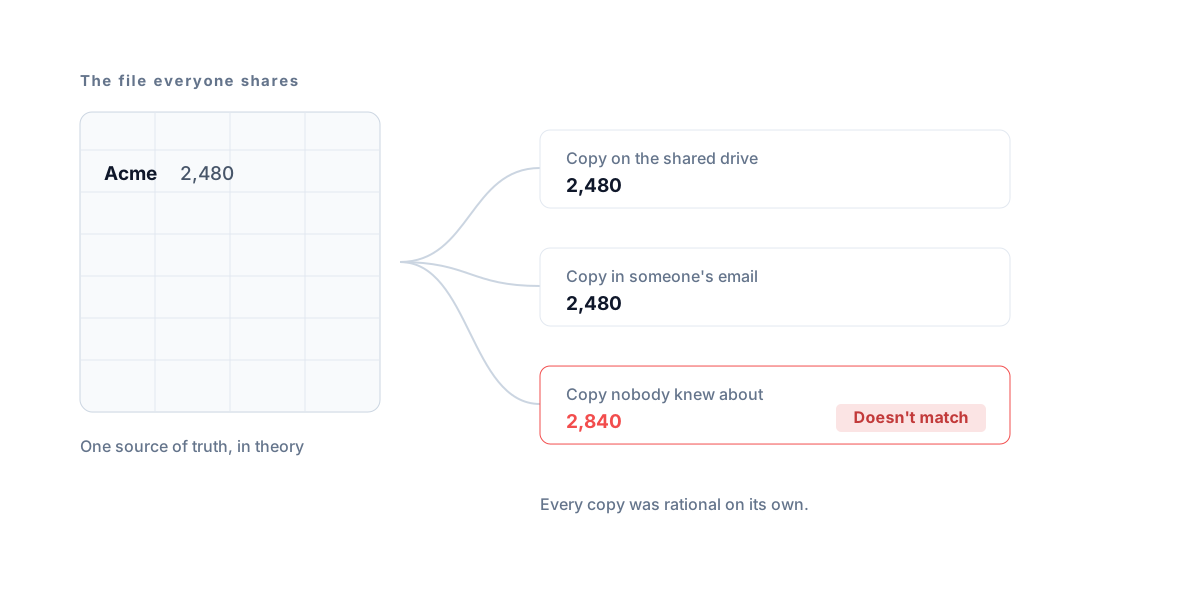
Duplicates are a symptom of distrust. Somebody made a copy because they were not confident the shared version would still be correct after other people touched it, and now two files exist with a slowly widening gap between them.
This is worth noticing because it is the point where the spreadsheet stops being a single source of truth, which was the entire reason for having it. Once there are two, there are usually five within a year.
3. A simple question takes a morning
"What is outstanding right now?" should take seconds. If answering it means opening three files, filtering two of them, and reconciling the results by hand, the cost is not the morning. The cost is every question nobody bothers to ask because the answer is too expensive to get.
That second cost is invisible and much larger. Businesses that cannot cheaply answer questions stop asking them, and then make decisions on impressions instead.
4. The same number appears in three places and they disagree
A client value typed into the CRM, again on the invoice, and again in the tracker will diverge. Not might, will, because the first time somebody skips a step there is nothing to catch it.
What makes this expensive is not the error itself but the reconciliation habit it creates. Somebody now checks the three against each other, regularly, forever. That is a permanent tax paid in attention.
5. Nobody knows who changed what
Version history in a shared sheet tells you a cell changed. It rarely tells you why, and it never tells you whether the change was approved. When a number moves and three people have plausible explanations, you have lost the audit trail that any process touching money eventually needs.
6. You have started building workarounds for the workaround
This is the clearest signal and the most commonly ignored. A macro that fixes the formatting the other macro breaks. A separate sheet whose only job is to reconcile two other sheets. A weekly meeting that exists because the file cannot be trusted without a human reading it aloud.
Each of these was rational on its own. Together they are a system nobody designed, maintained by people whose job is something else.
What to do first, which is not "buy software"
The instinct is to go shopping. Resist it for a week and do something cheaper: write down the three questions you most often cannot answer quickly, and the three tasks that take the longest for the least value. That list, not a feature comparison, is what should drive the decision.
Sometimes the answer is a better spreadsheet. Often it is an off-the-shelf tool that happens to fit. Sometimes it is something built around your process, which is worth reading about before you assume it is the answer.
When a spreadsheet is still the right tool
Being straight about this matters. A spreadsheet is still right when the process is genuinely ad hoc, when the shape of the data changes every month, when only one person will ever touch it, or when you are still working out what you need. Replacing exploration with software too early locks in a process you have not finished designing.
The signals above are about a process that has settled and outgrown its container, not about spreadsheets being bad. Most of the businesses we work with keep using them afterwards, just for the things they are actually good at.