
We build custom software, so treat what follows with the appropriate suspicion. That said, we turn away work regularly, and almost always for the same reason: the client was about to build something they should have bought. Here is the framework we actually use on those calls.
Off-the-shelf wins more often than studios admit
Buying is the right answer whenever your process is genuinely standard. Payroll, accounting, email, payments, storage: these are solved, regulated, and improved continuously by teams larger than yours. Building your own is a way of paying more for less.
Three specific cases where you should buy without hesitation:
- The domain carries compliance weight. Payroll, tax filing, clinical records. Vendors absorb regulatory change as part of the subscription. You do not want that job.
- The product improves without you. If the vendor ships features you benefit from, you are renting a roadmap. Custom software only changes when you pay for it to change.
- Other people need to interoperate with it. If your accountant, your clients, or your industry expect a particular system, being different has a real cost.
Three signals that point the other way
Custom starts making sense when the following are true together. Any one of them alone is usually not enough.
You use a small fraction of what you pay for
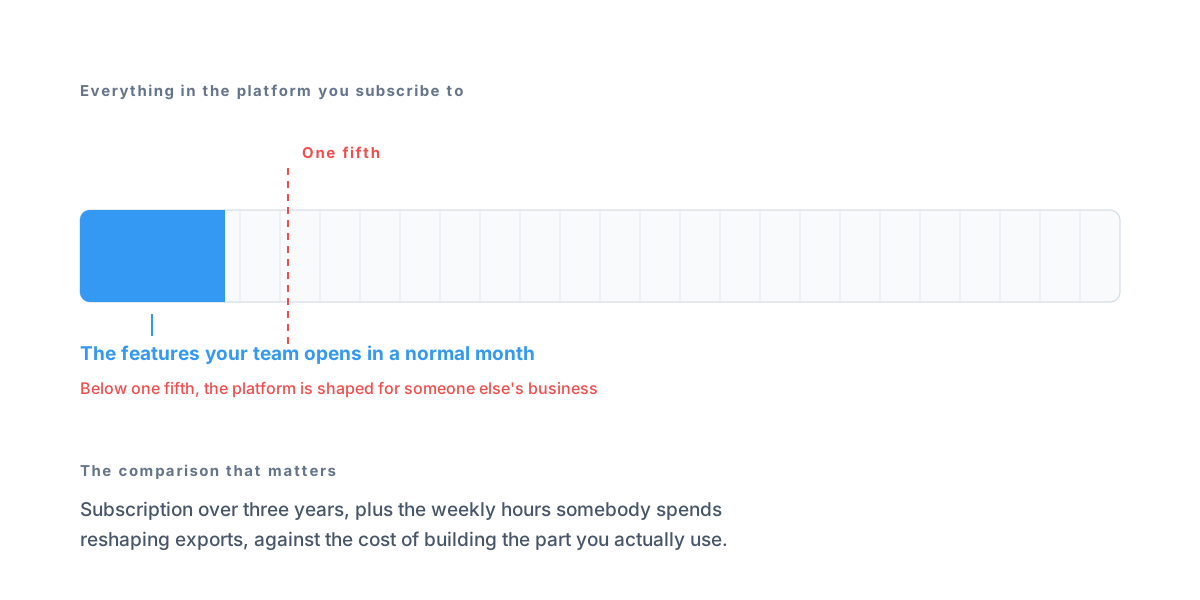
Open the tool you are considering replacing and count the features your team touches in a normal month. Under about a fifth is the point where the platform is shaped for someone else's business and you are paying for the difference. Under a tenth and the subscription is mostly buying you a login screen.
The workaround has become a job
Nearly every business running an ill-fitting tool has a person who exports from it weekly, reshapes the data, and produces the thing everyone actually uses. That person's time is the real price of the software, and it never appears on the invoice. Put an hourly figure on it and the comparison changes shape.
Your data lives in three places that disagree
When the same record exists in a CRM, an invoice, and a tracker, reconciliation becomes permanent work. Off-the-shelf tools rarely solve this because each one is trying to be the system of record. A tool built around your workflow can be the one place a record lives.
The cost comparison almost nobody does properly
The usual comparison puts a subscription against a build cost and stops there, which flatters the subscription. A fair version has four lines on each side.
Off-the-shelf, over three years: subscription per seat multiplied by seats and months; implementation or onboarding fees; the labour cost of the workaround, weekly hours at a real rate; and the cost of the decisions you cannot make because the data is not available.
Custom, over three years: the build; hosting, which for a business dashboard is usually modest; changes you will want in year two, which are real and worth budgeting for; and the risk that you scoped it wrong, which is highest if you skipped the discovery work.
Run that honestly and custom often looks better than expected, and occasionally much worse. The point is that you now have a number instead of a preference.
What you give up by building
Worth stating plainly, because it rarely appears in a studio's marketing:
- There is no roadmap but yours. Nothing improves unless you commission it.
- You own the maintenance. Dependencies age, APIs change. This is a small ongoing cost, not zero.
- There is no community. No forum, no tutorials, no consultant who already knows your system. Documentation and clean code matter more than people expect for this reason.
- Onboarding is on you. Nobody arrives already knowing how to use it.
How to decide in an afternoon
Do this before talking to anyone who sells either option.
- List the questions you cannot answer today in under five minutes.
- List the recurring tasks that exist only to move data between systems.
- For your current tool, count the features actually used in the last month.
- Price the workaround: hours per week at a real rate, multiplied by fifty.
If the answer to the fourth item is larger than a build, and the third is under a fifth, custom is worth a conversation. If not, you have just saved yourself a project.
If you do get there, it helps to know what actually drives the price and how to scope a first build so the conversation is concrete. You can also look at what we have built for other businesses to calibrate what one dashboard realistically covers.