The Benefits of Centralized Commercial Property Management Systems
Commercial property management is becoming increasingly complex. Managing multiple properties, tenants, leases, maintenance requests, vendors, and financial operations across different locations requires more than spreadsheets and disconnected software tools.
As portfolios grow, many commercial property management companies struggle with fragmented systems that create inefficiencies, increase administrative work, and limit visibility into operations.
A centralized commercial property management system solves these challenges by bringing all critical operations into a single platform.
In this article, we'll explore the key benefits of centralized property management systems and why they have become essential for modern commercial property management companies.
What Is a Centralized Commercial Property Management System?
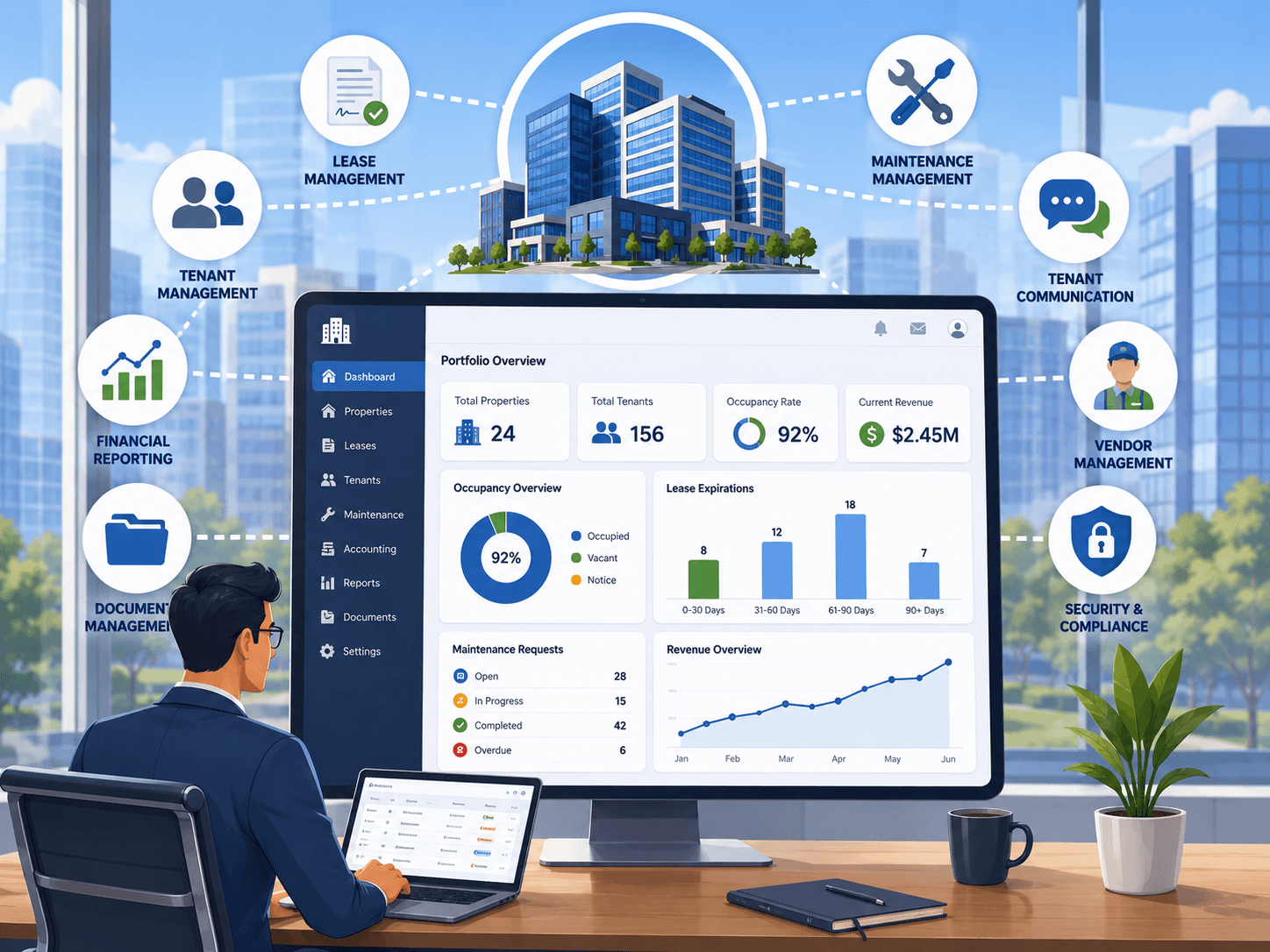
A centralized commercial property management system is a software platform that consolidates all property management functions into one unified environment.
Instead of using separate tools for:
Lease management
Maintenance tracking
Tenant communication
Financial reporting
Vendor management
Document storage
Everything is managed through a single system.
This creates a centralized source of truth that improves operational efficiency and decision-making.
Why Traditional Property Management Systems Create Problems
Many commercial property managers operate using multiple disconnected tools.
A common setup may include:
Accounting software
CRM software
Email platforms
Maintenance tracking systems
Spreadsheets
Document storage solutions
While each tool serves a purpose, they often create challenges such as:
Duplicate data entry
Reporting inconsistencies
Communication gaps
Lost information
Reduced productivity
Limited operational visibility
As portfolios grow, these inefficiencies become more expensive.
1. Complete Portfolio Visibility
One of the biggest advantages of a centralized system is having complete visibility across all properties.
Property managers can monitor:
Occupancy rates
Lease expirations
Maintenance requests
Financial performance
Tenant activity
Vendor performance
All from a single dashboard.
Benefits
Faster decision-making
Better portfolio oversight
Reduced operational blind spots
Improved management efficiency
Instead of searching across multiple systems, teams can access critical information instantly.
2. Improved Operational Efficiency
Commercial property management involves numerous daily processes.
Without centralized systems, employees often waste time:
Switching between software platforms
Searching for information
Updating spreadsheets
Entering duplicate data
A centralized platform streamlines workflows and eliminates unnecessary administrative work.
Results
Faster task completion
Increased employee productivity
Reduced manual effort
Lower operational costs
3. Better Lease Management
Commercial leases are often more complex than residential agreements.
Managing lease terms manually increases the risk of:
Missed renewals
Compliance issues
Revenue leakage
Documentation errors
A centralized lease management system can provide:
Lease tracking
Renewal reminders
Digital document storage
Critical date monitoring
Automated workflows
Benefits
Reduced lease administration workload
Improved compliance
Better revenue protection
4. Enhanced Tenant Experience
Tenant satisfaction directly impacts occupancy and retention rates.
Centralized systems improve tenant experiences by providing:
Faster communication
Self-service portals
Online payments
Maintenance tracking
Real-time updates
Modern commercial tenants expect convenience and transparency.
A centralized platform allows property managers to deliver both.
Benefits
Higher tenant retention
Better tenant relationships
Improved service delivery
Increased tenant satisfaction
5. Real-Time Financial Reporting
Financial visibility is critical for commercial property management.
A centralized system allows stakeholders to access:
Revenue reports
Expense tracking
Property profitability
Cash flow analysis
Budget performance
Owner reporting
Benefits
Faster reporting
Better forecasting
Improved financial control
More informed business decisions
Real-time reporting eliminates the delays often associated with manual reporting processes.
6. Centralized Maintenance Management
Maintenance operations become increasingly difficult to manage as portfolios grow.
A centralized maintenance system enables teams to:
Track work orders
Assign vendors
Schedule preventive maintenance
Monitor completion times
Analyze maintenance costs
Benefits
Faster issue resolution
Reduced downtime
Better vendor coordination
Improved tenant satisfaction
Maintenance becomes proactive rather than reactive.
7. Stronger Vendor Management
Commercial properties often rely on numerous vendors and contractors.
Managing vendor relationships manually can create inefficiencies.
A centralized platform helps property managers:
Store vendor information
Track performance
Manage contracts
Process invoices
Monitor service quality
Benefits
Better vendor accountability
Improved service quality
Reduced administrative workload
Better cost management
8. Improved Team Collaboration
Property management teams often work across multiple departments and locations.
Without centralized systems, collaboration becomes difficult.
A centralized platform ensures that:
Everyone works from the same information
Updates are shared instantly
Tasks are clearly assigned
Communication remains organized
Benefits
Better teamwork
Reduced errors
Faster issue resolution
Increased accountability
9. Increased Data Accuracy
When multiple systems are used simultaneously, data inconsistencies become common.
Common problems include:
Duplicate records
Outdated information
Reporting discrepancies
Human errors
Centralized systems eliminate many of these issues by maintaining a single source of truth.
Benefits
More accurate reporting
Better decision-making
Reduced administrative corrections
Improved operational reliability
10. Scalability for Growing Portfolios
Many property management companies eventually outgrow their existing systems.
What works for ten properties may not work for one hundred.
A centralized platform makes scaling easier by supporting:
Additional properties
More tenants
Larger teams
Increased reporting requirements
Complex workflows
Benefits
Sustainable growth
Reduced operational bottlenecks
Lower technology costs
Future-ready infrastructure
Essential Features of a Centralized Commercial Property Management System
When evaluating software solutions, look for features such as:
Property Management
Portfolio dashboards
Property tracking
Occupancy monitoring
Lease Management
Lease tracking
Renewal automation
Document storage
Tenant Management
Tenant portals
Communication tools
Service request management
Maintenance Management
Work order tracking
Vendor coordination
Preventive maintenance scheduling
Financial Management
Budget tracking
Revenue reporting
Expense management
Reporting and Analytics
Real-time dashboards
Custom reports
Portfolio performance insights
Automation
Workflow automation
Notifications
Task assignments
Security
User permissions
Data encryption
Audit logs
How Centralized Systems Improve Profitability
Many commercial property management companies focus primarily on operational benefits.
However, centralized systems also have a direct impact on profitability.
Reduced Administrative Costs
Automation minimizes manual work and improves efficiency.
Better Occupancy Rates
Improved tenant experiences support higher retention.
Improved Financial Control
Real-time reporting helps identify inefficiencies and opportunities.
Faster Decision-Making
Centralized data enables managers to act quickly and confidently.
Increased Asset Performance
Better maintenance and lease management protect property value.
The Future of Commercial Property Management
Commercial property management is becoming increasingly data-driven.
Property managers who continue relying on disconnected systems may struggle with:
Rising operational complexity
Increased tenant expectations
Growing reporting requirements
Portfolio expansion challenges
Centralized property management systems provide the foundation needed to manage modern commercial real estate efficiently.
Companies that invest in centralized technology today will be better positioned to compete and scale in the future.
Final Thoughts
A centralized commercial property management system is more than a convenience—it is a strategic asset.
By bringing leases, maintenance, tenant communication, financial reporting, and operational workflows into a single platform, property management companies gain greater visibility, efficiency, and control.
Whether you're managing office buildings, retail centers, industrial properties, or mixed-use developments, a centralized system can help streamline operations, improve tenant satisfaction, and support long-term growth.
As commercial real estate continues to evolve, centralized technology will become a key differentiator for successful property management companies.